
The story of Batgirl is the story of Barbara Gordon, an exceptional college-aged young woman turned vigilante, and the difficulties she faces not only as a crime fighter, but in her daily life as well. The series started off being written by Gail Simone and drawn by Ardian Syaf, then changed to the creative team of Cameron Stewart and Brendan Fletcher drawn by Babs Tarr, and featured cameo writers such Marguerite Bennett. The comic began as a dynamic read with an intense story – the struggles of the titular character allowing the reader to share in the tension of the moment and to relate and empathize with her. Batgirl’s struggles were both fantastical and realistic, pairing the life of a crime fighter with the character of an insecure young woman. Batgirl is a brave, intelligent, capable fighter who does not need Batman to save her or even help her. At the same time, the strength of her personality is tempered with all-too real doubts about her ability and her flaws.
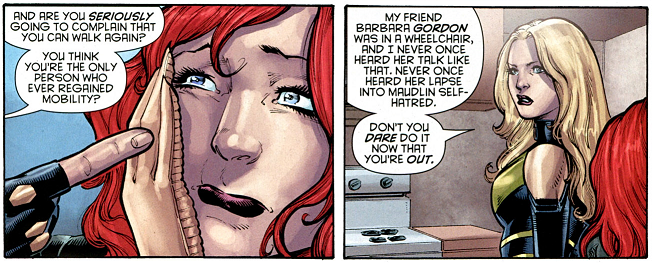
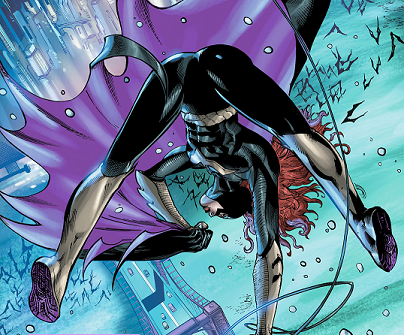
The comic run also covers traditionally “female” topics such as dating and relationships, without them detracting from the actual main plot of the story. Early in the series, Batgirl was confronted by Nightwing, her old boyfriend, and she had to come to terms both her previous feelings for him and her need to stand by herself. This sets up the dichotomy of confidence and doubt that pervades through the whole series. There were romantic subplots in “Batgirl,” but they did not dominate the comic. In fact, Batgirl proves to be a role model for taking things into one’s own hands – when the world needs a hero, you become one. In a flashback issue in which a mega-flood threatens Gotham City, Batgirl (then Barbara Gordon) spends the majority of the issue dealing with her inner turmoil – her need to protect her home and family, her feeling helpless to do so, her fear for her father the police commissioner – only to come to the conclusion that she needs to take things into her own hands. “Wait for a hero? Barbara Joan Gordon – be your own damn hero” (Bennett, Batgirl, 24.1A). As for the art in the comic, there were several oddly positioned poses featured, though most of them seem more to highlight musculature rather than female anatomy. The poses were slightly exaggerated, but for the most part seem actually physically attainable by someone who is very athletic and has trained to do them. Batgirl is portrayed as physically fit, with a thin yet proportionate body with no over exaggerations on the breasts or hips. Batgirl’s costume is fairly modest, with no exposed skin and even includes logical armored plating. It should be noted that from Issue 35 onward, the stories took on a different tone with more emphasis on more traditionally “female” subplots. The character doesn’t change – Batgirl is still capable and realistic – but the side stories become notably more “girly” with emphasis on girl friends, parties, and relationships. For example, in Issue 35, Batgirl moved to a different area with her friends, got drunk at a party, and had to deal with the fallout from her hangover and near hook-up the next morning, all while tracking down a data thief. Whereas previously the stories could be considered as similar in intensity to that of Batman comics, at that point the tension fades. The art too, becomes more cartoon-y rather than detailed. This doesn’t detract from the character, however it does seem to be a step backward compared to the incredible work that earlier issues were.
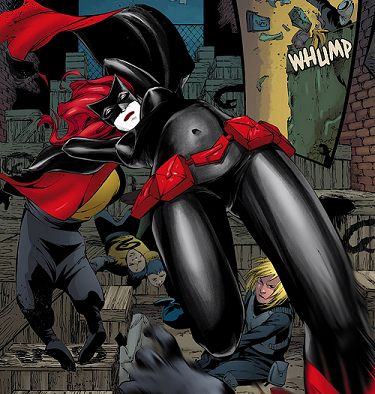
Kate Kane is many things – a lesbian, ex-soldier, and a survivor of a tragic childhood – on top of being Batwoman. She is at once a tough, strong character, while at the same time hindered by serious character flaws such as anger issues and fluctuating alcoholism. This not only makes her a believable, but also allows readers to relate to her on a personal level. In the first few issues alone, Batwoman is forced to face the ghosts of her past as a villain causes her to have visions of her dead sister which she had not emotionally come to terms with. Overall, the Batwoman series is a mixed bag. Having the main character be an openly lesbian character was a progressive step forward; increasing inclusion of different types of female characters and breaking the trope that women have to be limited to loving men. Batwoman herself was incredibly well portrayed. She is strong, well trained, and intelligent, but still very human. At one point after a fairly dangerous fight, Batwoman aggressively pushed away her would-be sidekick and cousin, Bette Kain, despite her desire for company, in order to keep her safe. Moments like that displayed a level of compassion that added depth and personality to the character. Romantic subplots in Batwoman comics worked very similarly to those in Batman – they supported the plot and sometimes carried it, but they were not the point of the comic. Throughout the series, Batwoman formed a serious relationship with a female detective named Maggie Sawyer who advanced the story at times, giving Batwoman (as Kate Kane) information in casual conversation that lead to different parts of the story. The series contained a mostly female cast, and all were well-developed characters that were important to the story, rather than just plot points or decorations. At one point, the supporting characters staged a confrontation with Batwoman, forcing her to admit to them that she had been blackmailed into helping an underhanded company by providing it information. The only male in the room at the time was her father. However, there were points in the series that contain unnecessary amounts of nudity such as changing scenes or sex scenes. These moments were unnecessary to the story and portrayed Batwoman in an overly sexual way, despite her not being an overly sexual character. In addition to that, the art of the comic was incredibly, unnecessarily sexual. Batwoman’s body was drawn in drastic detail, with emphasis on her breasts and hips, showing details like her belly button through her leather suit. It was almost as if the character was drawn naked, then colored to hide that fact. It didn’t detract from the character herself, but it proved to be a distraction from the plotline of the comic. The original writing team of “Batwoman” – J.H. Williams III and W. Haden Blackman – resigned from writing the comic at Issue 24 citing creative issues with DC comics. Among other reasons, the publisher refused to allow them to show Batwoman marrying her girlfriend (Williams III). Until that point, the artist had alternated between Amy Reeder, Trevor McCarthy, and Williams himself. Marc Andreyko stepped in as the new writer with art fluctuating between Trevor McCarthy and Georges Jeanty. This team brought with them a more classic comic style and more familial based sub plots. Batwoman’s character remained the same, but art changes and the over-sexualization seemed to taper off.
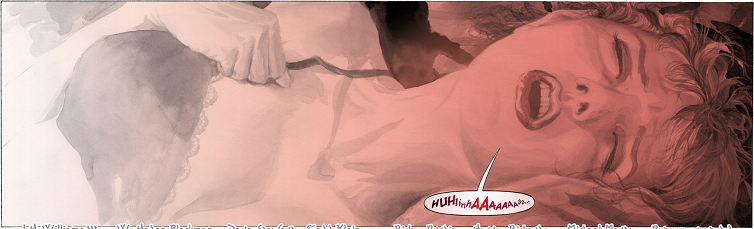
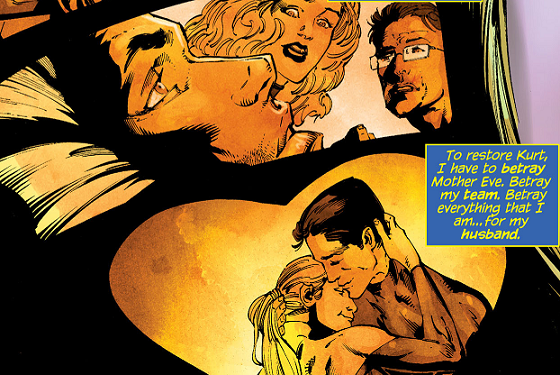
Birds of Prey is a series that followed a nearly all-female superhero team by the same name. The original main characters were Black Canary (Dinah Lance), Starling (Ev Crawford), Katana (Tatsu Yamashiro), Batgirl (Barbara Gordon), and Poison Ivy (Dr. Pamela Isley). Later in the series, the lineup changed to include new characters known as Strix (Mary Turner) and Condor (Benjamin Reyes) who was the only male member of the team. The first notable thing about the team was that, despite the roster being nearly entirely female, none of the costumes were overly sexual. All of the costumes were form fitting and most of them included sculpted breast plates, but there was no excess of nudity or unnecessary, extreme detail. The art was occasionally over sexualized – the characters being drawn in odd positions or at odd angles to show off their bodies – but it didn’t prove to be overly distracting from the story or dialogue. In fact, the only character that was portrayed in an overly sexual way was the character that uses her sexuality to her advantage on a regular basis – Poison Ivy. In the first issue in which Ivy joined the team, she used her plant pheromones to sexually manipulate a man into telling the team the information they needed. It was sexuality in line with the character and plot, not sexuality for the sake of sexuality. All of the characters were well depicted with personality, story, and background driving the comic rather than it being just a group of “sexy ladies” kicking and punching.
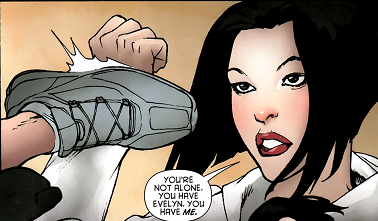
For the most part, each member of the team had her own character arc, developing her as a person and not just a prop. The overarching theme of the comic seemed to be friendship and comradery, and while this is generally considered to be a more feminine theme, it was presented in a way that wasn’t limited by gender. The Birds of Prey dealt with friendship and betrayal in a higher stakes superhero environment – it wasn’t just girls becoming girlfriends. Also, while Condor may have been the only recurring male character, his presence was not of utmost importance to the plot – the series could have continued either with or without him there. The “Birds of Prey” series did not require a male character to drive it. At Issue 18, author Christy Marx took over for the previous author, Duane Swierczynski. Artist Romano Molenaar remained until Issue 29 when he was replaced by Robson Rocha. The notable difference from that moment on was that the romance subplots become much more prevalent, eventually tearing apart the team. Black Canary was torn between her beliefs as a hero and her love for her husband who, until recently, she had thought dead. There is also a minor love triangle between Black Canary and Condor, which added more romantic drama to the series. The story went from being action driven with character development to being a statement on Black Canary’s love life – a boring trope that proved to be a major step back for the series. As interesting and strong as the main characters were, if the plot of the comic is just a woman angsting about love, it loses its flare as a superhero story.
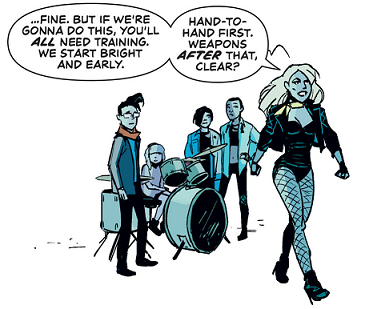
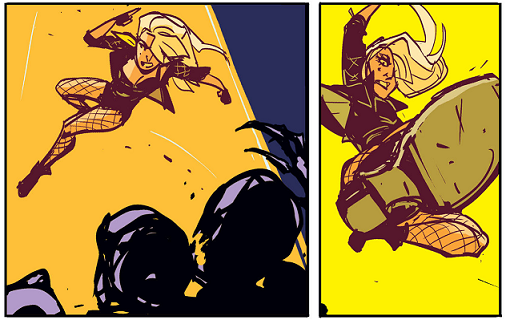
After the cancellation of Birds of Prey, Black Canary was given her own title series written by Brenden Fletcher and drawn by Annie Wu. This series attempted to mix “girly” themes with traditional super hero themes from the very beginning. Black Canary went directly from a superhero team to joining a band as its lead singer. Her costume became more sexualized and more edgy, and the driving plot of the comic was that she must protect a child from aliens. Despite the overall “Josie and the Pussycats” feel of the comic, the explanation as to why Black Canary was now in this role seemed fairly solid. While the plot relegated her to a more maternal position, Black Canary’s character was not weakened or lacking because of it. In fact, Black Canary stepped back into the leadership role that she lost in Birds of Prey through all of the drama associated with her love life. When the alien plot was revealed, she took it upon herself to teach her band members self defense and how to use guns for the sake of protecting their young guitar player. Even the costume can be marginally explained away as the punk rock fashion attributed with the band. The art of this comic was far from sexual despite the costume, and if anything, it added to the “girly” feel of the series. The comic had a mostly female cast, and each character had a distinct personality which played a part in the story. The comic was quite obviously geared towards a female audience, but not in an obtrusive, forced way.
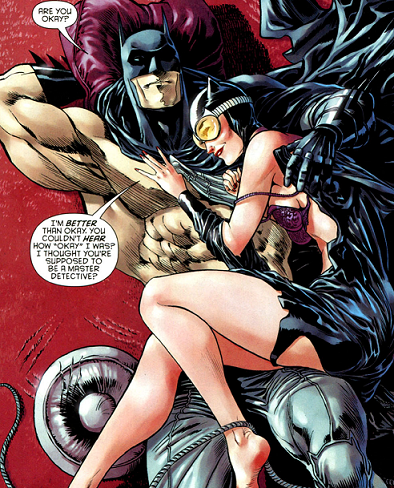
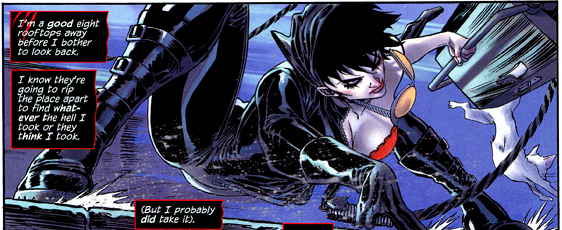
Selina Kyle is Gotham city’s best thief, the prolific Catwoman. Going into this, one expects a level of sexuality as Catwoman has a pre-established history of being sexualized. However, from the beginning of the series, one is assaulted with an excess of sexual images and poses. The first comic began with a half-dressed Catwoman leaping out of a window to escape a band of thugs and ended with her having fairly graphic sex with Batman for no reason. It’s one thing to have a character sexualized, but this was overwhelming, and just in the first issue. Catwoman was consistently drawn in a variety of awkward poses, most of which seemed unattainable by any human. Despite the excess of sexuality, Catwoman does mention that she is aware and in control of her proclivities, only seeking them out on her own terms. On one hand, the sexual themes were incredibly over the top, but on the other hand, the character owned her actions, showing strength in the face of societal expectations. Catwoman used her attractiveness to her benefit. For example, when referring to one of her informants, she introduced him to the story saying, “This is Bertrom. He wants to have sex with me, so this keeps him loyal” (Winick, Catwoman, 14.1C). This is at the same time an odd mix of disgustingly sexist and empowering. Women are allowed to be sexual creatures, but to show it in such graphic detail for no reason is using the character as a sexy sign to draw in readers. It should be noted that Batman – who appears occasionally throughout the comic – was drawn hyper-muscularized and sexualized as well. Catwoman was full of such conflicting themes. Catwoman herself is capable, strong and clever, yet a continuous subplot of the story was her feelings for and reliance on Batman. For example, it was a fight with Batman that drove her to start working with a partner again. At Issue 13, author Judd Winick and artist Guillem March were replaced by Ann Nocenti and Rafa Sandoval, and from that moment on Catwoman became almost emotionally reliant on Batman, despite him very rarely showing up physically in the comic. At Issue 35 the creative team changed again, this time to writer Genevieve Valentine and artist Garry Brown, who gave the series a more film noir aspect. Catwoman became the heir and leader of a crime family, then boldly tried to unite other crime families and get them to work together for the better of Gotham. The character of Catwoman became emotionally stronger, less expressly sexual, and more intellectually intriguing – focusing more on Selina Kyle rather than her leather-clad alter ego. Despite Batman still being a major catalyst in the storyline, the subplot remained an undercurrent to the story proper, rather than it being much more front-and-center aspect as before. On top of that, the art became more stylized and the poses seemed much more attainable. The comic also began to draw quotes about or from notable women in history such as Elizabeth I and Cleopatra, integrating them into the storyline. In summary, after Issue 35 Catwoman became more about Selina Kyle as a character, and less about Catwoman showing off her body and getting into trouble. One thing that stays consistent through the comic however was that Catwoman created strong relationships with other well-developed female characters, and none of these characters were overly sexualized or pointless. Catwoman’s friends Lola and X were both well-developed and never shown in a sexual way. It seemed the extreme sexualization was reserved for Catwoman herself.
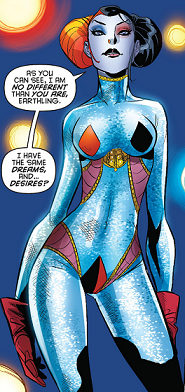
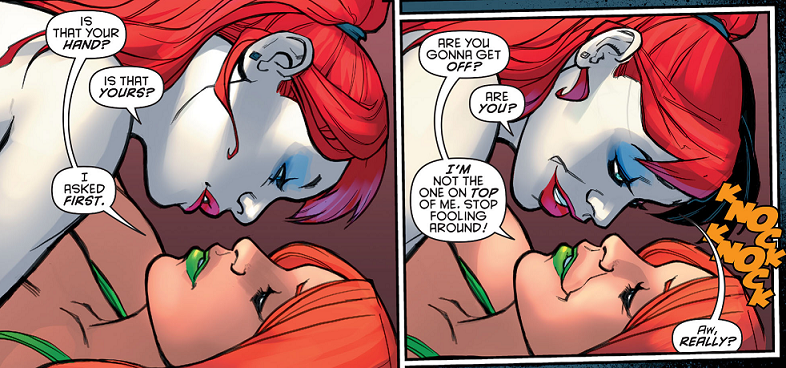
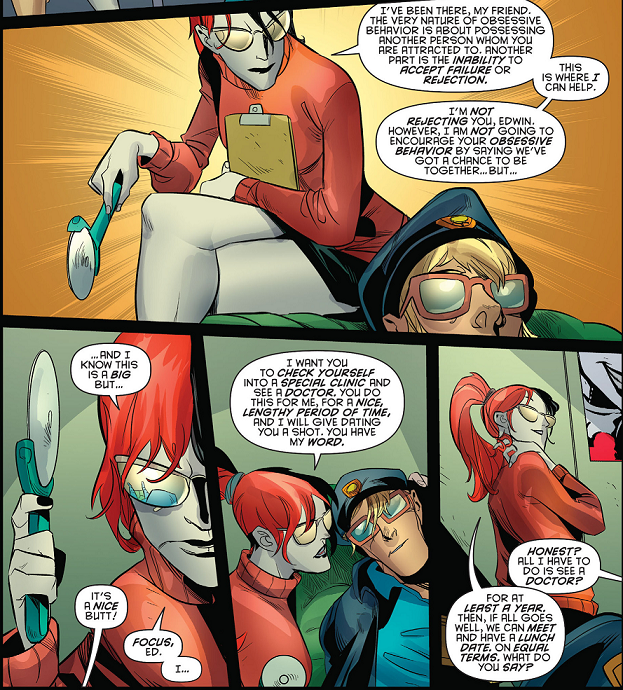
As a character, Harley Quinn has gone through many changes in recent years with the release of the New 52 as well as several video games. In the past she was a psychologist at Arkham Asylum where she met and became obsessed with the Joker, going so far as to join him in a life of crime. This series covered her often zany antics after she broke away from the Joker, realizing that her obsession was unhealthy and often times harmful to her. On one hand, this in itself is an impressive message; Harley broke her dependence on the Joker and struck out on her own, showing that a woman does not need her man to exist. On the other hand, the series had its drawbacks, namely the over sexualization of Harley Quinn herself. Her costume has gotten continually smaller – currently reduced to a corset top, short shorts and knee high boots. This started the series off on the wrong foot already, but the over sexualization didn’t stop there. Throughout the series, the comic was rife with anything from unnecessarily sexual panels and angles, to whole scenes that were pointlessly sexual and add nothing to the plot. Unlike other super heroines, Harley wasn’t portrayed with unrealistic sexual poses – most of her action poses were fairly straight forward – however she was continually drawn at angles that specifically highlighted her chest and rear and in various states of undress. For example, when she received a delivery, she had the delivery boy follow her up the stairs while wearing nothing but her underwear. The panel was drawn at an angle where the highlight of the scene is her behind. Male characters in the series continually remarked about how sexy Harley is, treating her as if she was simply an object of pleasure for them, and while she ignored the advances or made jokes about them, she rarely refuted them. There were also many whole scenes throughout the series that added nothing to the plot and only prove to make the comic “sexier.” For example, in Issue 9 Harley joined a burlesque show, in Issue 10 Harley and several girls went skinny dipping, in Issue 15 there was a scene that implies sexual activity between Harley and Poison Ivy, and this was all in addition to a plethora of changing and shower scenes, none of which held any relevance to the plot of the comics.
However, despite the amount of unnecessarily sexual art and themes throughout the comic, the series did have its strong points. All of the supporting female characters had a personality and at least a slight purpose to contribute to the subplots of the comic. Poison Ivy acted as an anchor to Harley in several instances, taking care of her when she was in danger. At one point, she stayed with Harley all night to help identify the source of several the regular slew of assassins that made attempts on Harley’s life. Harley herself surprisingly acted as a role model for other characters when handling issues of forgiveness and obsession, and while the Joker made minor cameos in flashbacks or dream sequences, the plot of the comic was not driven by Harley needing him around. That being said, the “independent woman” theme wavered continually throughout the book as Harley occasionally bemoaned her lack of a boyfriend in her life. Overall, Harley Quinn is another jumble of mixed themes and messages.
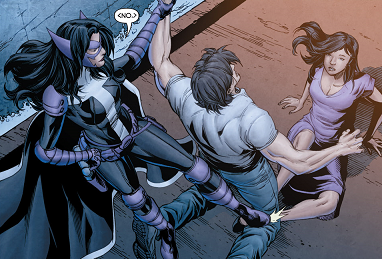
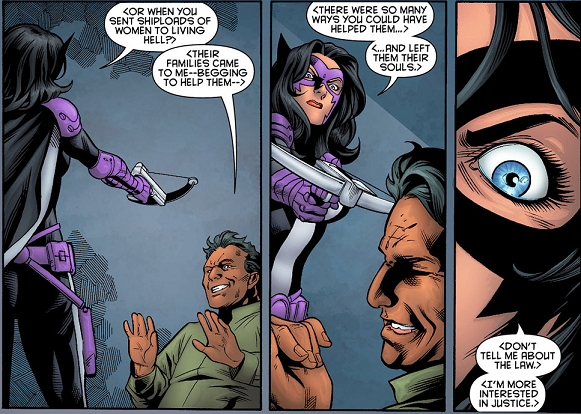
This series began strongly, immediately introducing Helena Wayne, aka Huntress, as an independent character. Written by Paul Levitz with art my Marcus To, within the first few pages Huntress disassociated herself from men, claiming they all get distracted and are simply convenient when she needs them. This could be seen as female superiority, but the concept was not explored any further and it played no real part in the overarching plot of the series. The plot was however, about Huntress fighting for the rights and safety of women. The character traveled to Italy where she discovered a sex trafficking ring and set about destroying it to free the women and save others that might have fallen prey to it in the future. The story was compelling, and the theme of women supporting other women was inspiring. In addition to this theme, the art for the series was mostly practical. Huntress’s costume completely covered her with no exposed skin, while at the same time remained attractive and memorable. It even included practical features like armored areas and utility belts. The character was also only drawn sexually when it furthered the plot of the comic, with only one minor changing scene. In order for Huntress to get more information about the sex trafficking ring, she had to play the part of rich tourist and ordered a sex worker. The scene with her in lingerie was brief and served to further her investigation rather than to just show her skimpy clothing. The only drawbacks to the series were that the action poses seemed to imply that a woman’s body can bend in a way that is not physically possible. These kinds of poses are very rare in male characters. The poses were not overtly sexual, but they were a little ridiculous and seemed impossible to achieve. There were occasional headlines in the comic that seemed slightly sexist, but they only served as the taglines on covers and didn’t exist inside the actual dialogue. For example, in Issue 2 of the series, the tagline on the cover page was “danger has never looked this good” (Levitz, Huntress, 1). Would this tagline be used if it were a male character featured on the front? Regardless, the writing and art for the comic were strong and Huntress was neither over sexualized nor was her story contingent on a male character.
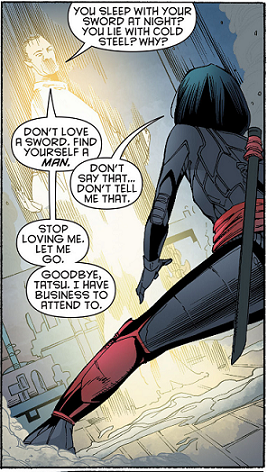
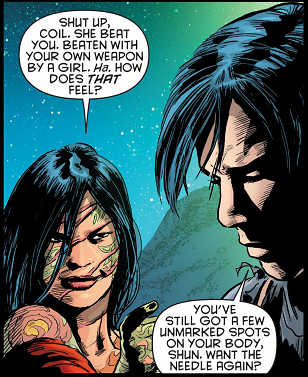
This story began right away by effectively giving the middle finger to the concept of women being weaker and less capable than men. On the second page of the very first issue, Tatsu Toro (Katana, also Tatsu Yamashiro from Birds of Prey) was locked in what appeared to be a losing battle with one of her villains, Coil, when he mocked her and all women. He said, “Women are weak from centuries of doubt and humiliation. It is not in a woman’s blood to be master of anything, except perhaps her kitchen” (Nocenti, Katana, 2). By the end of the issue, she had not only defeated him, but his clan of swordsmen, disproving his words through action. Despite this strong start, the plot of this series and the character of Katana were singularly driven by the male characters in the story. Katana herself sought to destroy the Sword Clan because she believed they killed her husband. The story circulated around the one strong female lead being guided and driven by male peers and love interests. The majority of the comic revolved around Katana’s previous love triangle with her husband Maseo and his brother Sickle. In at least one flashback, she lamented about loving both and being unsure who to choose. While Katana herself proved to be defiant to gender stereotypes, she was the only notable female in the story for over half the series. The other female recurring characters were outliers and placeholders at best, until one finally developed into a character. Katana also continuously grappled with herself, trying to come to grips with her dependence on her husband (whose soul she believed was trapped in her sword) and her attraction to his brother. The character was strong, but required a male presence despite that. In theory, as a Japanese character the purpose of this was to draw on elements of what the creative team perceived as a traditional Japanese relationship. However, this was poorly done and the attempt only muddled the story and the character. As for the art in the series, there were very few sexual moments, and all of them had a purpose to the story. While there was an occasional nude scene, it only showed her back and served to emphasize the extent of the damage she received in her previous battle. While there was a sex scene early in the series, it took place in a nightmare and proved to further Katana’s own character development. Katana was also not victim to excessively sexual action poses or a skimpy costume; her costume proved to be modest and practical and at worst her action poses seemed strange and unattainable. While the series and character were not outright weak or insulting, the good was almost perfectly balanced with the bad, which made the comic decidedly neutral at best.
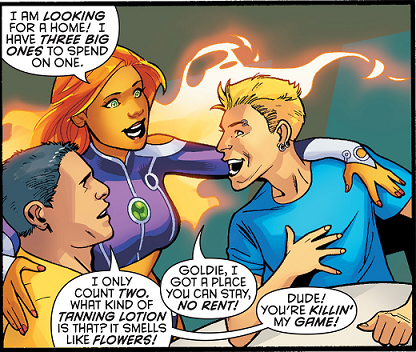
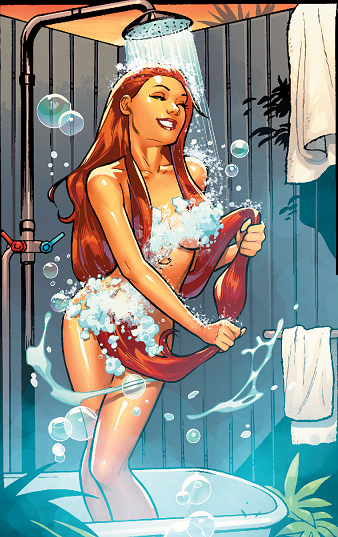
From the first issue, the Starfire comic series was a disappointment. The titular character is an alien princess named Koriand’r – shortened to Kori – who is new to Earth. Except she wasn’t. Even in the new 52, Starfire had been written as a member of a team in Red Hood and the Outlaws, yet this series truly played up the clueless, innocent princess trope. Consistently she was treated like a piece of meat by men in the comic, who fought over her and made sexual advances while she was none-the-wiser. She was treated as a cute object of lust, despite being the main character. Starfire wore very little, though the costume was an improvement from ones she had in the past. The given justification of the costume was that the character gained her powers from the sun and therefore must expose herself to it. However, this defense is weak at best when there are male characters that also gain their power from the sun (ex. Superman) and still manage to be fully clothed. In addition to this, Starfire seemed to randomly seek out physical attention for no advancement of the plot. For example, in the very first issue, she was seen speaking to a man, then two panels later she kissed him. Also in the first issue there was an unnecessary shower scene with a full page length panel of Kori completely nude save some conveniently placed suds. It is one thing to be free and confident in ones appearance and sexuality, but scenes like that are effectively useless to the plot except to further the characterization of Starfire as a sexy dope. The only redeeming quality to the series was that the (only) other female supporting character, Sheriff Stella Gomez, was immediately established as a capable character with personality and intelligence. She played the part of handler for Kori, reining the alien princess in when she made a mistake and guiding her through the everyday aspects of human life. Despite the strength of Sheriff Gomez as a character, this comic was sexist, insulting, and at best induced an eye roll. It was very likely going for funny, but it failed at that as well.
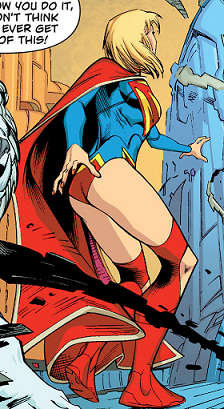
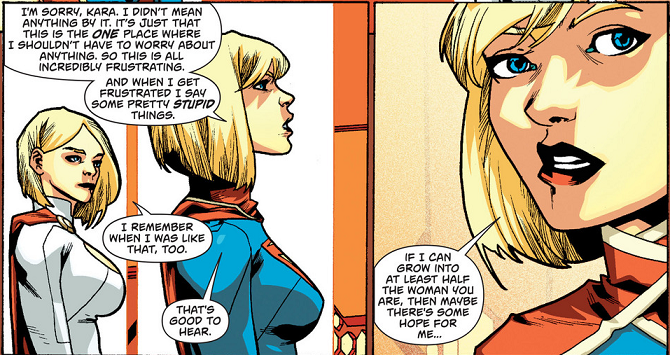
At the same time, Supergirl is both Kara Zor-El, teenaged survivor of the planet Krypton, and super powered cousin to Superman, hero and defender of Earth. This series handled this duality well, creating a balance between the fragile teenage girl who lost her home and the tough superhero the world knew as Supergirl. First and foremost, Kara was a teenager and acted like one – stubborn, occasionally moody and belligerent, and had an interest in boys and friends that became a driving point of her character. In an older character this would have been vaguely problematic, characterizing women as immature and strictly “female.” But when looked at in context of age and progression, Kara’s apparent flaws seemed more reasonable and even realistic. Coming from a lost world to Earth, she mourned the loss of her family and friends, seeking comfort in others and appearing a tad naïve, but at the same time, despite her personal turmoil, she proved herself innately heroic, helping those that need it without delay. Throughout all 40 issues of this series, Kara never truly let go of her past and her traumas, but she did handle them as a real person would – sometimes relying on others, sometimes struggling alone. Kara proved that emotion was not weakness, and tempered her personality flaws with strength and confidence. One of the earlier plot arcs of the series involved Kara falling in love with a man who manipulated her and used her, promising to go back in time and save her home world of Krypton. Despite her love for him, Kara did what was right and managed to stop him from sacrificing the universe to bring back Krypton. The plot was thoughtful and not entirely driven by romance, but the parts that were act as heavy character development for Kara and not just romance because a female character requires it. Moreover, Kara maintained relationships with male characters but did not rely on them, nor were any of her storylines completely driven by them. The male characters in Kara’s life played a part in her story, not the other way around. Superman visited her when he was having a personal crisis. Superboy relied on her to back him up when he was in danger. Kara was the support for her male counterparts while still standing on her own. Kara also formed deep personal friendships with other female characters without ever having a rivalry with them. She met and befriended Powergirl despite a complicated clone subplot, and any friction in their relationship was caused by Kara’s own insecurities and not the need for “girl vs. girl” cat fights. Visually, Supergirl’s costume was not overly revealing, and as she was a teenager, her proportions were more modest than other female characters. Her action poses were sometimes awkward, and she was often drawn in positions that were mutedly sexual and impossible to attain (ex. her body twisted so that both her rear and chest were in full view). She was also too often drawn from angles that put emphasis on her rear. Regardless of the awkward positioning, Kara as a character was strong, sensitive, capable, and as realistic as any female character read to date.
Arguably the most well known female super heroine in the world, the Wonder Woman series goes hand in hand with expectations. Wonder Woman (Diana Prince) is a feminist icon dating back to the second wave of feminism in the late 60s. It is safe to say the modern series did not disappoint. The first 35 issues, written by Brian Azzarello and drawn by Cliff Chiang, include a powerful story with a lot of character development and depth. The catalyst to the plot was indeed a man – Wonder Woman discovered that she was the daughter of Zeus and not born of clay as the legends go – but the story was about how the discovery of this fact effected Diana and her surroundings. Immediately a female supporting character was introduced and developed throughout the series, forging a friendship with Diana over several issues. In the first several issues, Diana pledged herself to protect this woman and her child, despite barely knowing them. Other female characters were introduced as well, each given a personality and piece of the plot, and all of them forming some sort of relationship with Diana herself.
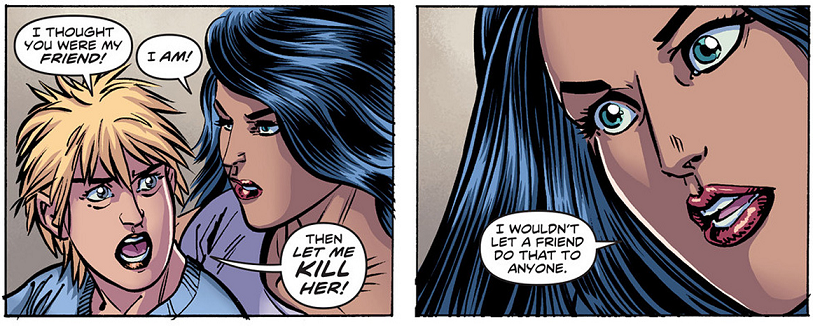
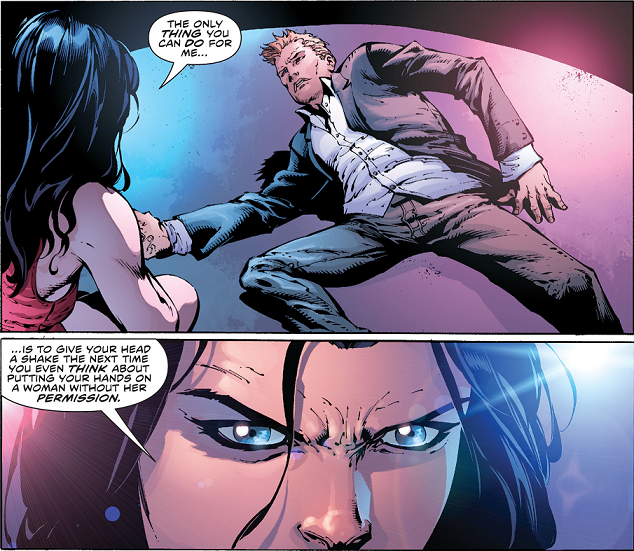
Diana’s newfound siblings, the other amazons, and Queen Hippolyta played minor parts in the plot, but contributed to Diana’s character development. The series featured an array of deep and sometimes complicated, personal friendships between all of the female characters without said characters falling into old tropes such as girl vs. girl or shaming one another for whatever reason. The series also explored the deeper theme of compassion without weakening the character of Wonder Woman. She managed to love and care for other characters without losing her toughness or her fighting spirit. When her friend’s was distraught over the loss of her newborn, Diana was a rock of compassion, staying steady and rational, figuring out the best way to move forward, despite the emotional situation. Even in the face of danger, Diana showed compassion and love to all, trying to save rather than to defeat. However, this does not stop her from defeating her enemies if necessary. While the plot and subplots in the series included male characters, the stories were not centered or reliant on them and neither were the characters. The male characters were well-developed and added to the story without Diana relying entirely upon them or the plot being contingent upon their presence. Above all, the story was about Wonder Woman, her growth as a character and her friends. She developed bonds with the other female characters despite adversity, even going so far as to swallow her pride and beg to a goddess for the sake of her friend. Meredith Finch took over writing at Issue 36 and David Finch took over drawing, and while certain things changed the character remained as strong as she was in the beginning. Throughout the series, Wonder Woman refused to be bound by anyone’s will but her own, defining her as an independent character that relied on friends and family only when she needed to. This proved to be both strength and a flaw for her, adding more to her depth of character. In Issue 42 of the series she demanded that right for other women as well, physically shutting down a man who came on to her forcefully, grabbing her against her will. She threw him across the room and stood up for all women saying, “Give your head a shake the next time you even think about putting your hands on a woman without her permission” (Finch, Wonder Woman, 7. Top).
There was occasional minor nudity in the comic but it was not presented in a sexual way. Instead, it displayed Diana’s confidence in her appearance and presence. The costume was approximately the same as her classic look which, while somewhat revealing, was not over sexualized and proved to be more iconic than anything else. Throughout the series, Diana’s street clothes remained fairly modest yet attractive, giving her a look that presented her as a person first while not denying her beauty. The biggest drawback with the series came with the change of artist from Cliff Chiang in Issues 1-35 to David Finch in Issue 36 and beyond. In the first 35 issues, Wonder Woman was drawn large and imposing – a muscular woman who looked every inch the way one would imagine an Amazon warrior looking. After Issue 35 however, Wonder Woman (and every other female character in the comic) was drawn considerably more slender and more traditionally “feminine.” While this did nothing to detract from her character, it did appear be forcing her into standard western societal requirements to make her seem more “pretty.” For a character like Wonder Woman, whose defiance of the world’s patriarchal expectations makes her exceptional, it seems counterproductive to change her appearance to make her fit the mold of what men think is attractive.