
To understand comics, one must understand the comic creation process. Once the concept for the comic has been reviewed and approved, the writer or writing team for the comic book creates a hard plot which develops into a script. Depending on the team, this script may or may not include plot notes for the artist in reference to the visuals. Once the editor approves the script, the artist or art team creates thumbnails digitally or in pencil based on the script and the notes. The thumbnails then go back to the editor, and occasionally the writer, for approval before the whole project is inked and colored, thus creating a final draft. With that complete, the letterer inserts the dialogue and thought boxes as well as all of the text and the completed comic gets one last check before it heads to print and publication. (Larson)
Since serialized comics began, there have always been female readers. However, in a media form originally geared toward a male audience, female characters have, in the past, been overlooked as inconsequential. One notable exception, however, was the DC Comics character Wonder Woman. In December 1941 DC Comics introduced the character in its title All Star Comics. Arguably the best known female comic character of all time, Wonder Woman set the standard for comic book superheroines. Wonder Woman became the first female superhero to star in her own title comic. In her book The Secret History of Wonder Woman, Jill Lepore claims that Wonder Woman “was a Progressive Era feminist, charged with fighting evil, intolerance, destruction, injustice, suffering, and even sorrow, on behalf of democracy, freedom, justice, and equal rights for women.” (Greenhouse 35 - 40)
Despite being written by a man – psychologist William Moulton Marston – Wonder Woman was designed to reflect the feminist ideals of independence, strength, and compassion. However, even these seemingly progressive intentions were jaded by the male gaze. Wonder Woman, feminist icon, and all of her Amazonian sisters, were weakened by men. If Wonder Woman were to be bound by a man, she could not break free. If a man were to visit the Amazonian home, Paradise Island, the entire Amazon population became powerless. In a letter to a comics historian in reference to Wonder Woman, Marston is quoted as saying:
Frankly, Wonder Woman is psychological propaganda for the new type of woman who should, I believe, rule the world. There isn’t enough love in the male organism to run this planet peacefully. Woman’s body contains twice as many love generating organs and endocrine mechanisms as the male. What the woman lacks is the dominance or self assertive power to put over and enforce her love desires. I have given Wonder Woman this dominant force but have kept her loving, tender, maternal and feminine in every other way. Her bracelets, with which she repels bullets and other murderous weapons, represent the Amazon Princess’ submission to Aphrodite, Goddess of Love and Beauty. Her magic lasso, which compels anyone bound by it to obey Wonder Woman and which was given to her by Aphrodite herself, represents woman’s love charm and allure by which she compels men and women to do her bidding. (Stanley 143 - 171)
While the view of women as being strong and capable is a classic feminist doctrine – a cornerstone to feminist beliefs from the beginning of the movement – the beliefs that they are not as self assertive as men, submissive to men, or that they are limited to maternal traits and compassion is not. Wonder Woman was created from contradictions, with both feminist ideologies and ideologies that are decidedly not.

Wonder Woman was introduced to the comic book world during the Golden Age of comics, which ran from 1938 to 1945. But as the Golden Age came to an end, the comic industry was shaken by declining readership. As societal expectations of women changed with the times from the 1950s to the late 1960s and early 1970s, so too did their portrayal in comic books. Wonder Woman had degraded from proud Amazon princess into an ever weakening character, whose stories revolved more around romantic subplots and fashion than heroics. It was the swell of second-wave feminism in the early 1970s that revived Wonder Woman’s heroism. Gloria Steinem published the first issue of Ms. magazine with a picture of classic Wonder Woman on the cover (Stanley 143 - 71). According to Stanley, “Steinem firmly cemented Wonder Woman’s link to contemporary feminism by publishing a collection of Marston stories in a book format, simply entitled Wonder Woman, which also featured commentary and an analysis, “The Amazon Legacy,” by Phyllis Chesler.” (Stanley 143 - 71)
While Wonder Woman has made her mark as a feminist icon and paved the way for other mainstream comic heroines, women in comics have traditionally been treated as sexual objects or lesser characters compared to their male counterparts. Supergirl for example, introduced in DC Comics title Action Comics in May 1959, shares all of her Cousin Superman’s powers, and yet was still portrayed as the one in need of protection and care from Superman. Michael Lavin states, “Women were typically relegated to the role of girl-Friday, victim to be rescued, seductive vamp, or perhaps, the long-suffering girlfriend.” (Lavin 93) Yet as the Women’s Liberation Movement progressed through the 1960s and into the 1970s, the two big publishers made attempts to change to meet the times, trying to make female characters mimic women in real life. This continued through the 1980s with the invention of heroines such as Ms. Marvel, Spider-Woman, Storm, and She-Hulk. Female characters were becoming more dynamic as well, with realistic back-stories, detailed interpersonal interactions, and interesting plot lines. Yet despite the development of these characters, the view of comic book heroines as sex objects still lingered. Lavin cites Marvel’s character the White Queen as an example – a complex character with psychic powers whose costume is nothing but a white bustier, thigh-high boots, and panties (Lavin 93). The over-sexualization of female characters reached a peak in the 1990s when Marvel Comics and the slightly smaller Image comics released several “swimsuit issues,” showing mostly female characters posing evocatively in revealing swimwear.
Some would argue that characters like Supergirl, regardless of how subservient and second class she may seem to Superman, are more of a critique of the views of femininity of the day. Alex Link states, “Close attention to her early adventures reveals ways in which her readers are more specifically invited to emulate her efforts to secure limited freedom while under the ever-watchful gaze of patriarchy.” (Link 1177 - 97) Link implies that Supergirl’s struggle is to maintain the cover that she is not extraordinary – to hide her power and her abilities – to be socially accepted by both her cousin and the world at large, which in turn relates her to the women of the time. This struggle between inner power and outer presentation echoes the struggles of the everyday woman. Link claims that “Supergirl's adventures nurture the desire for independent empowerment in its readers.” (Link 1177 - 97)
The late 90s brought with it an era of darkness over the comic book world. Comic stories grew grittier and more violent, and this violence was disproportionately directed at female characters. In DC Comics’ Batman universe alone, a Batwoman was murdered, a female Robin was tortured to death, and the iconic Batgirl was shot in the spine by the Joker, who then proceeded to take vulgar pictures of her (Cochran 23 - 26). Violence against female characters became so common place that comic writer Gail Simone began to keep track of these incidents and coined a term for this treatment: “women in refrigerators.” The term itself comes from an issue of the Green Lantern in the mid 90s where the titular hero comes home to find his girlfriend strangled and shoved in the fridge. In her article “The cold shoulder,” Shannon Cochran quotes an email interview with Simone on the subject:
I and some make friends started making a list of the characters that had been killed, mutilated, or depowered (also a telling trend, as the more powerful a female character was, the more likely it was that she would lose those powers). It was shockingly long, and almost no one in the already small pool of valid superheroines escaped the wave of gynocentric violence. (Cochran 23 - 26)
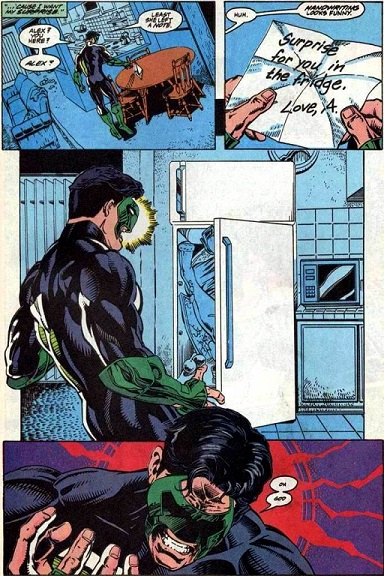
Simone’s list contained over 90 female characters. Simone continues by explaining that proportionally, women in comics are killed or violated more often, and in much more gruesome ways than male characters. Using this list, Simone contacted various comic creators of both genders for their response, which in turn sparked much deliberation in the comic book community (Cochran 23 - 26).
While Simone’s work may have lit the fire, other female fans kept it burning. Blogger Mary Borselino was disgusted by the torture and violent death of the female Robin, and after receiving feedback of a very similar nature from many fans, she started the website Girl-wonder.org. This website is not limited to just protesting the treatment of the one character, but all misogyny in the comic industry, from characters, to creators, up to and including comic book shops that are or are not welcoming to female fans. The site organized appearances at conventions to speak for anti-harassment and equal treatment of women. The site has stagnated in recent years, with no news posted since 2012 (Borsellino).
Slowly hearing the cry of the distressed female fan, comics in the last 15 years have grown much more progressive than in previous years. Female characters have grown from sex objects and sources of male angst, to intelligent, well-thought-out characters. Skimpy costumes and violence remain a constant in the industry, but to a much lesser, and much less extreme extent. In 2004 Marvel Comics launched a reboot of its She-Hulk series with writer Dan Slott at the lead. In the series, the titular character She-Hulk had to face not only the challenges of the life of a superheroine, but also the balance between that and her equally important, high profile job as a lawyer. The series lasted to just under 100 issues and explored many female empowering themes such as work/life balance, sexual double standards, the common trope of underdeveloped female characters in comics, and even sexual assault. Tammy Oler explains the importance of the series, “She-Hulk was a thoughtful look at women's agency and the ways that women can wield power at a time when most comic book creators thought that simply including a bad-ass woman somewhere in the lineup was good enough.” (Oler 17 - 19)
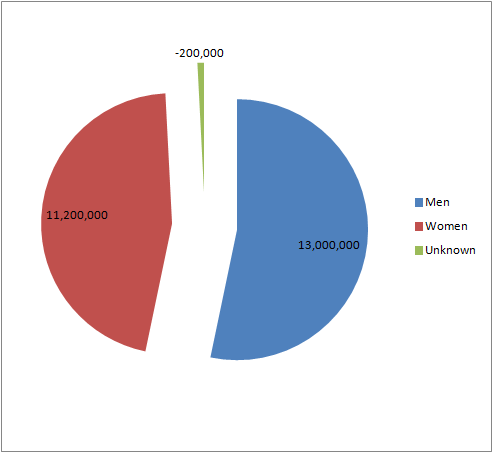
More recently, mainstream comics have seen an influx of female creators and readers. A Facebook study posted by popular comics journalism site Comics Beat shows that not only is the number of comic book fans at a new high (likely due to recent comic to movie adaptations such as “Man of Steel” and “The Avengers”) but female readership makes up over 46% of that. Moreover, of the 5.8 million fans of female character lead comics specifically, over 62% of them were women (Schenker). In addition to these findings, approximately 40% of attendees at both New York and San Diego Comic Cons were female as well (Gregory; Carrasco). More women are reading comics today more than ever.
Despite the influx of female readership, up until recently, comic book culture had a tendency to exclude women, both in title roles and in creative roles. In 2011, DC head executives were confronted in a panel at San Diego Comic-Con about why less than 1% of their creative team were women. According to Christian Sager, this all traces back to risk and money. Sager says, “It’s a financial risk for mainstream publishers to hire female creators outside of their conventional circles, it's also a risk to produce comics with women as the target audience.” (Sager) However, in recent years these statistics have been increasing. In 2014 the number of female creators at DC Comics had risen to 9.8% and at Marvel Comics 10.8%, with female characters making up approximately 30% of total cast for each publisher (Reese). A large gap remains, but the growth is notable. Out of the 21 comic series in this study, nine are written by female writers and five are drawn by female artists.
Comics have also grown much more inclusive – working in new LGBTQ characters, as well as characters of diverse races and backgrounds. In 2011, DC Comics announced its intentions to reboot and renumber its established comics continuity in an effort they called the “New 52.” USA Today broke the news of the release. Journalist Brian Truitt wrote in a follow up story on the release that the company’s emphasis on, “diverse characters such as lesbian superheroine Batwoman, Hispanic hero Blue Beetle and African-American adventurer Cyborg (who will be a core member of Johns and Lee's new Justice League) also will continue.” (Truitt) Many female mainstays of the DC universe, such as Catwoman, Wonder Woman, and Batwoman got their own title book with the implementation of the New 52. DC even re-launched the title “Birds of Prey,” an all-female lead super team.
The inclusion of the new female-lead titles has been seen as a progressive step forward for the company. However, the New 52 has received a lot of criticism for the portrayal of female characters as a whole. Upon review of the reboot, Scott Thill referred to it as an, “underwhelming heap dominated by middling comics peddling casual ultraviolence, post-millennial sexism and surly superheroes in search of reasons to exist in a world needing champions more than ever.” (Thill) In similar opinion, Trevor Gentry-Birnbaum cites the treatment of female characters in the New 52 as one of the major things wrong with the reboot. He accuses DC of, “a kind of invisible sexism that allows DC to say they have titles devoted to female characters, but still parade them around as trollops for fanboys’ amusement.” (Gentry-Birnbaum)
One year later, Marvel Comics released news of its Marvel NOW! initiative, what the head editors call a “ReEvolution” of the comic publisher. In the official press release to the public and concurrent interview with head editors, Marvel Chief Creative Officer Joe Quesada addressed what new steps would come of this event:
Number one, costume changes. Number two, you’ll see characters there that you wouldn’t necessarily think would be in a piece like that. I think readers can assume that we’re going to make a big push with certain books and create certain books that involve a lot of these new characters. And also just changes to certain status quos based upon costume design and what happened. (Morse)
With the Marvel NOW! initiative, the company released several titles with popular female leads, including Storm, Elektra, and Captain Marvel. Newer releases include Ms. Marvel – starring a young, female, Muslim superhero – and A Force, an all-female team of Avengers. Also, Marvel has passed the title of Thor from the former and familiar son of Odin, to a new, female character.
The response to the Marvel NOW! initiative has been fairly positive, with Ms. Marvel both a New York Times bestseller and a previously no. 1 top selling graphic novel on Amazon (Roberts). There have been some who question the motivations of the move though, calling it a possible push for media attention. Giaco Furino cites flat sales as a cause, saying “there's the unavoidable fact that these diverse comics receive much more amounts of press and attention than is usually lavished on comics.” (Furino)
Despite all of these developments, there are still steps to be made to progress the plot of the female comic book character. Comic writers like Gail Simone (Batgirl) and Kelly Sue DeConnick (Captain Marvel) still speak out against the treatment of women in the comic industry. According to DeConnick, “If you can take out your female character and replace her with a sexy lamp and your plot still functions, you're doing it wrong. I just want our female characters to have their own motivations and complexities." (Dockterman 76 - 80) Female readers are a growing demographic and are drawn towards strong, capable, and practically dressed female characters. In order for the comic industry to grow to meet this new demand, it must analyze the female characters that have become a deeply rooted part of their respected universes, and consider whether or not it reflects the desires of its no-longer-entirely-male audience.