
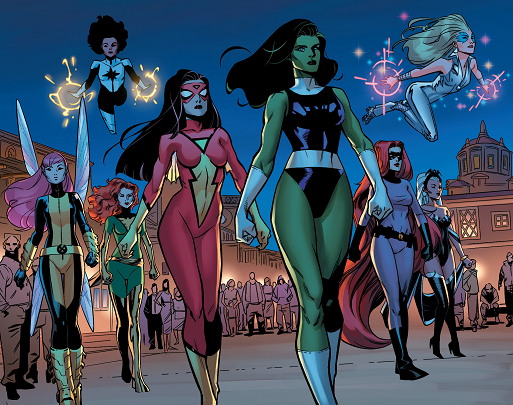
The concept behind A-Force was that the universe had fractured as a result of the machinations of Dr. Doom and now an entirely female super hero team defends and protects a little island of peace called Arcadia. Most of Marvels big name female characters were in this series, but not all of them had speaking rolls. The series is written by Marguerite Bennett and G. Willow Wilson and was drawn by Jorge Molina. The plot began by making the setting seem like a veritable paradise. The characters in the comic all relied on each other and defended each other, working together as a team. In the first issue, a strange shark attacks the citizens of Arcadia, and the ladies of A-Force are work together seamlessly to save lives and protect civilians. While the background plot of the series hinged upon a male character, the story was more about the women dealing with their troubles in paradise rather than him. And since the story arc with Doom encapsulated the entire Marvel universe at the time, it was impossible not to include him to some extent. The nearly entirely female cast was made up of women of varying races and ages. The characters appeared to be well portrayed, but the series has very few issues released to date so it was difficult to make a judgment. The conflict that arose in the story created friction between one of the younger female characters, Nico Minoru (Sister Grimm) and the leader of the team Jennifer Walters (She-Hulk), but it was character and plot driven conflict rather than girls fighting for the sake of fighting. Throughout the story, She-Hulk in particular appeared to struggle with her responsibilities and her feelings while at the same time leading fairly and dealing with the issues that arose. She was portrayed as a strong, yet flawed character that cared deeply for her friends and teammates. When one of their own, America Chavez, broke the rules and had to be banished, She-Hulk was distraught over her inability to save the other hero. She spent several issues trying to deal with the failure and grew more determined to not let it happen again. The majority of the costumes for the comic were fairly modest with very few of them showing excessive amounts of skin and very little unnecessary detail, though there were a few exceptions – some wore no more than bathing suits. The comic also appeared to lack any odd or over sexualized poses or scenes, presenting the women as characters rather than objects to look at. However, the art portrayed every character as slender despite the muscle mass that should have been associated with them. For example, Captain Marvel (Carol Danvers) and She-Hulk are both heavily muscled characters, yet in the art style of the comic they were drawn with the same body type as everyone else. This detracted from the look of the comic rather than the story and characterization, but in a comic with so many different female characters it worked against the series to force all of them into the same standard of beauty.
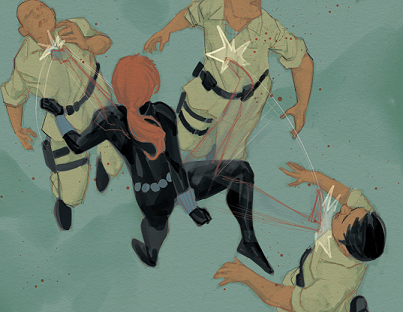
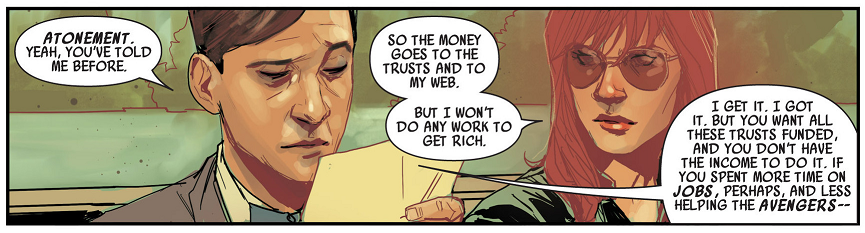
The whole theme of Black Widow was that Natasha Romanov (Black Widow) seeks redemption from her past and wished to atone for her past mistakes. This plot carried through the entire series, setting up the story to be very character driven. This type of redemption arc wasn’t seen in any of the other series covered, and is often used in comics centered on a male protagonist. The series opens with Black Widow taking on a dangerous mission and after its completion she returned to her accountant for the next one. She mentioned several times that she was not doing these missions to benefit or get rich, but instead to help pay back those she had wronged throughout her life. Black Widow herself was a very duty-minded, capable individual, not bound by any lines or rules the way other Avengers were. She ran by her own set of morals and was driven by her own desires, not relying on any other characters, male or female. This defined her as a loner – separating her from all supporting characters with the possible exception of her lawyer, Isaiah. This proved to be the biggest flaw in the series, as there was a near complete lack of supporting female characters and interactions throughout. The closest recurring female character was Maria Hill, Director of S.H.I.E.L.D., and she only appeared to further the plot and direct Black Widow through her missions. At one point, Maria claimed that she relied on Black Widow and that she saw Widow as a confidant, but she immediately followed that up by saying that it was only because of Black Widow’s distance from others. In one issue, Black Widow teams up with a female X-men character, X 23, but the team up had no preface and it was over just as suddenly. There were several flashbacks in the series that implied Widow’s closeness to a female friend, but later in the flashbacks Widow kills said friend with no apparent remorse. One could argue that this was intended to cement Widow’s status as a loner, but the act of needlessly killing another female character and the lack of interactions with other female characters in addition to Widow outright stating it seemed excessive. The series began by framing Widow to be strong and incredibly capable – the world’s best secret agent. She regularly managed to both think and fight her way out of tight situations, saving lives and ending them. She was also presented as a good character, if not morally jaded. She had no problem killing for information, but stood up for her neighbor who had been regularly beaten by her husband. Widow was a balance of personal morals, strengths, and ferocity that made her seem very three dimensional. The series contained a minor romantic subplot with the Winter Soldier (Bucky Barnes), but it was more of a footnote to the story and affected him far more than her. For a character that was traditionally drawn in a skin-tight leather bodysuit, the art in this comic was much more toned down. The costume fit snugly, but it lacked the extreme detail other costumes have had, and looked more like clothing than a second skin. The action shots and angles were fairly believable and didn’t objectify the character at all. There were a few scenes showing Widow after a shower, but she remained completely covered and not overly sexualized. Overall, the somewhat sketchy art style of Phil Noto, the artist for the series, kept the panels looking more dramatic than sexual. With this style of art, Black Widow’s appearance was striking, but didn’t detract from the plot.
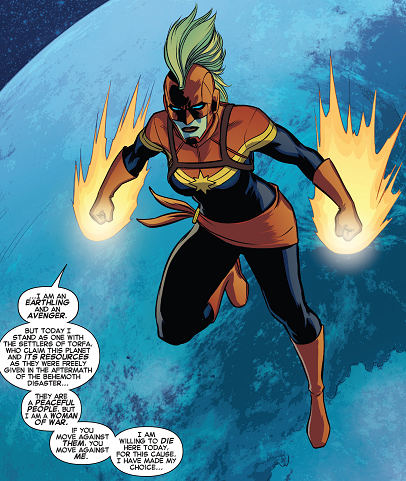
Originally, the character Carol Danvers was a member of the military and a reoccurring side character in many superhero stories. Eventually, she gained her own powers and became the hero Ms. Marvel. In 2012, Danvers dropped the old name and costume and got a new series written by Kelly Sue DeConnick and drawn by David Lopez, taking over the name Captain Marvel from another superhero who had bequeathed it to her. The series immediately portrays Captain Marvel as a well-rounded character, mixing personality with capability. On one hand she took in and helped care for a mother and her daughter who were in need, and on the other hand she stopped both petty crimes and higher threats with ease. Captain Marvel made the act of being a superhero look easy, but still had a very human side. She was kind and caring to the child who saw her as a role model, and even went out of her way pulling strings to give an old woman one of her dying wishes. Moreover, Captain Marvel took up several leadership roles with ease, commanding attention and respect without shutting down her subordinates. The male recurring characters deferred to her judgment when she led, with no mention of sex being an issue. This factor made her seem both more heroic and more human given the character’s military background. She was also unafraid to get hands on in combat situations, but went out of her way to protect others. This played more into the duality of strength and softness that defined her throughout the series. The underlying plot of the series was Captain Marvel’s search for herself. On Earth she was beginning to disassociate with who and what she was and she felt the need to separate herself from familiar surroundings in order to find herself again. This theme of self discovery, while similar to other series in this study, is unique as it features a grown woman who sought to re-define herself, not because she was made to by some outside catalyst, but because she felt it was what she needed to do. This put her in control of her own story, not the other way around.
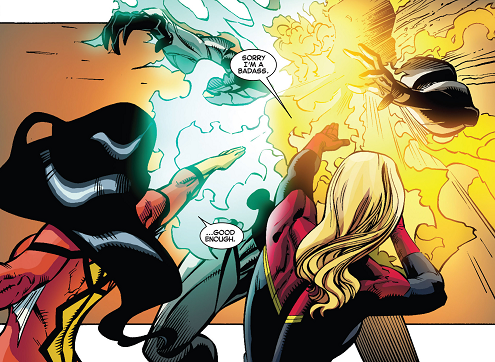
Throughout the series, there were many female supporting characters that not only furthered the plot, but also played a solid role in Captain Marvel’s search for herself. It was with their support that she came to terms with who she was again. Even when tempted with a power boost which came with a price, Captain Marvel had the strength to refuse thanks to her knowledge of herself and the support of her friends. Female characters also recurred through the series in leadership roles, which showed that it didn’t have to be just the main character taking charged. There was a romantic subplot in the story, but it not only remained a discrete addition to the character, but the romantic interest supported Captain Marvel’s decisions to do what was best for her. When she confronted him, telling him that she wanted to go to space and find herself, he responded, “I will be many things for you, Carol Danvers, but… I’m never gonna be the one that holds you down” (DeConnick, Captain Marvel, 20.4A). Once again keeping with her military background, Captain Marvel’s costume was more of a uniform than most superhero costumes. There was no skin showing and the design of the costume didn’t accentuate her body in a way that was excessively detailed. Captain Marvel was never drawn in a sexualized pose, and was rarely drawn in unrealistic positions (mainly when meant to convey that the position was painful). Overall, the costume was still visually appealing with no unnecessary sexuality.
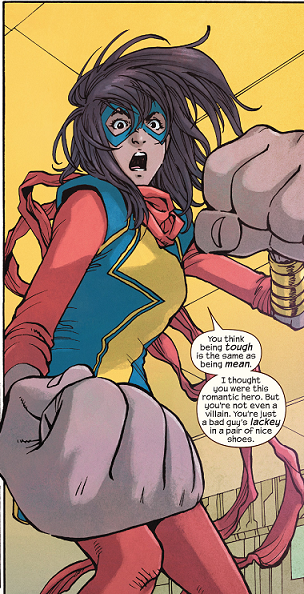
Kamala Khan is a teenage girl born to a traditional Pakistani family. After sneaking out one night she is accidentally exposed to a strange mist – the “terrigen” mists – and develops super powers allowing her to shift her mass and change her shape. She decides quickly that she wants to help people by being a superhero and takes the name “Ms. Marvel” after the hero she admired growing up. After the character of Carol Danvers gave up the moniker of “Ms. Marvel” in favor of “Captain Marvel,” the name went unused until this new series was introduced to the Marvel universe. Almost immediately this series differentiated itself from others by the main character alone – there have been very few teenage, Muslim superheroes, let alone female ones. Because the comic follows the exploits of a teenager, one would anticipate a level of femininity in respect to the plot, but this was of lesser importance to the series than expected. The themes explored in Ms. Marvel ranged from family ties and obligations, to personal expectations and fitting in, to the importance of support and friendship. In the very first issue, Kamala snuck out against her parents will, expressing her dissatisfaction with her familial expectations. Despite that, she was still conflicted due to her love for her family. Kamala spent more of her time trying to figure out who she was and what her place in the world was than being interested in love or boys. While romance became a factor considerably later in the series, it mainly served to further the plot and muddle Kamala’s concept of who she could trust. Her love interest betrayed her, imprisoned her, and tried to manipulate her into fighting for him. Yet Kamala managed to gather her confidence in the end and overcome him on her own, both mentally and physically. Throughout the series, friendship and family proved to be continually more important to the story than romance. Kamala saw Captain Marvel, along with the other Avengers, as role models, desiring to help people with her powers. It is this that drove her to becoming a superhero – her need to do good. Her mix of this need with her teenaged insecurities made her a very realistic and well-developed character. From the beginning, Kamala had a well characterized female best friend, Nakia, who supported her and imparted wisdom when necessary. The drawback to this was that, while Nakia was Kamala’s stated best friend, she didn’t take an active role in the comic nearly as much as Kamala’s male best friend, Bruno. As a character, Bruno began with a slightly sexist edge, insisting that he take care of Kamala and claiming he felt emasculated when she took matters into her own hands. However, this changed as the series progressed and he became more accepting and even more helpful to Kamala and her role as a superhero, even going so far as to accept and cherish her friendship over his unrequited romantic feelings for her. While Kamala being a Muslim hero is a very progressive step at inclusion, it became a back and forth issue with the comic as the culture portrayed was very male-centric. On one hand, Kamala was expected to obey unwaveringly and only interact with males on a friendship basis and only with the permission of her family. On the other hand, Kamala broke those rules and defied her parents, but out of a desire to do good and save lives (most of the time) rather than rebellion for rebellion sake. The comic is written by G. Willow Wilson, herself a convert to Islam, who approached the relationship between Kamala and her religion with both respect to a modern world and a young character. As would be expected for a Muslim superhero, Ms. Marvel’s costume was very modest, covering her entire body in a way that appeared that it would be acceptable to a Muslim family like Kamala’s. The character is never sexualized in any way throughout the comic as it would have detracted from the characters struggles and made her seem less real.
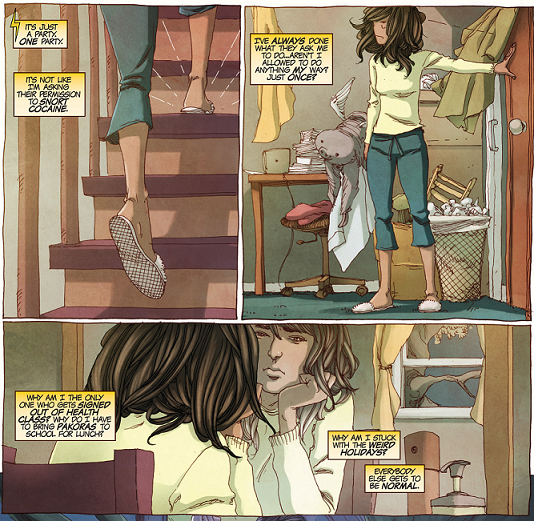
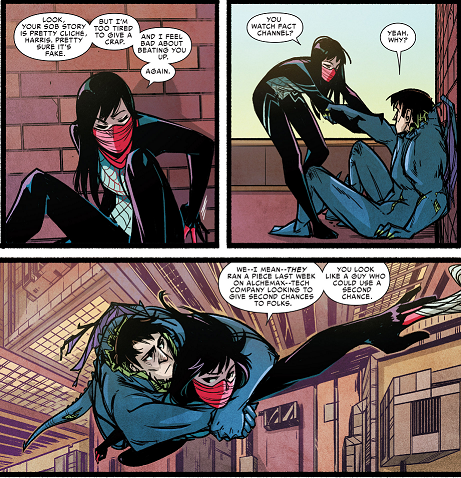
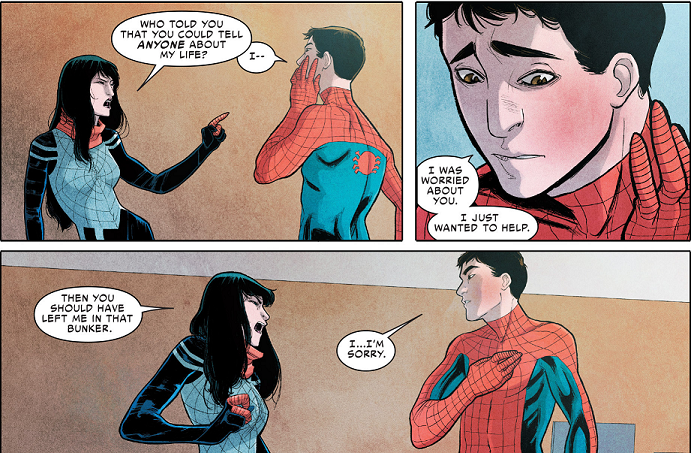
Cindy Moon aka Silk is a young woman who was bitten by the same radioactive spider that bit Spider-man. After developing spider powers similar to her male counterpart, she was locked away in a bunker for 10 years in an attempt to save the world from a threat that would be attracted to her powers. While the premise of the series sounded like a vague imitation of Spider-man, the character and the story managed to set themselves apart. Right away Silk was set up as a flawed but capable character, giving her a certain level of believability. She was not the flawless female Spider-man; she was her own character, with family issues and baggage that drive her plot. As Cindy, Silk struggled to fit into a world from which she felt disconnected, and as Silk she struggled to control her powers and fight crime while still battling her inner turmoil. At the same time she balanced a job with the local newspaper while trying to track down her family which had gone missing prior to her escape release from the bunker. Cindy dealt with guilt for not being there, a need for her family, and an awkward disassociation with social life that despite her attempts to blend in. A drawback to the series was that because of Cindy’s lack of social skills, there were very few supporting female characters. She had a few friends, but they were side characters at best, not interacting with Cindy enough to have a significant impact. The series included romantic subplots, but they did not drive the entire story, and while they affected Silk personally, they did not shift to the foreground. Even the issue that focused on Silk going on a date with the Human Torch was more about Silk’s own emotional state rather than the romance itself. Silk was a capable fighter despite being a little rusty, and even amidst her own inner turmoil and doubt she inherently sought to do good and help others. She even discovered that one of her initial villains was just a desperate father trying to make a living for his daughter. She not only helps him find a job outside of crime, but saves both him and his daughter when they were placed in turmoil by another villain. This painted Silk as a well rounded, well developed character and added to setting her apart from Spider-man. While she relied on her male counterpart heavily for the first couple issues – she had to be saved by him in the very first one – over the course of the series she began to detach herself from him and end her dependence on him. This not only showed independence, but also more character development. One of the villains of the story was Black Cat, a pre established Spider-man villain who shifted her focus to the new threat, setting herself up to be the lead villain of the current story arc. In previous comics, Black Cat’s costume was over sexualized, usually drawn unzipped down to the rib cage and showing an excessive amount of cleavage. In this series, her costume changed to something much more practical, but kept in the same look and feel of the old one – sans the nudity. This helped to establish her as a full character and villain, rather than a sexy distraction. Silk herself wore a costume that was fairly modest and was drawn with realistic proportions, with no unattainable or hyper-sexualized battle poses. The biggest drawback to Silk was the character’s somewhat unnecessary flashbacks to her previous relationship before her containment. One could argue that these scenes acted as character development for Silk, but to date they had proven to be irrelevant to the overarching plot of the comic other than to prove that Silk, at one time, had a boyfriend.
Like Silk, Spider-Gwen is a relatively new character to the Marvel universe, created for an alternate universe where Gwen Stacy, friend and deceased girlfriend of Spider-man, was bitten by the radioactive spider instead of Peter Parker. The series followed Gwen’s exploits as Spider-woman in her own universe. Much like Spider-man, Gwen was a plucky character with a quirky sense of humor and sometimes crippling self-doubt. She was portrayed as a very real, very human character struggling with her desire to redeem herself and be a hero.
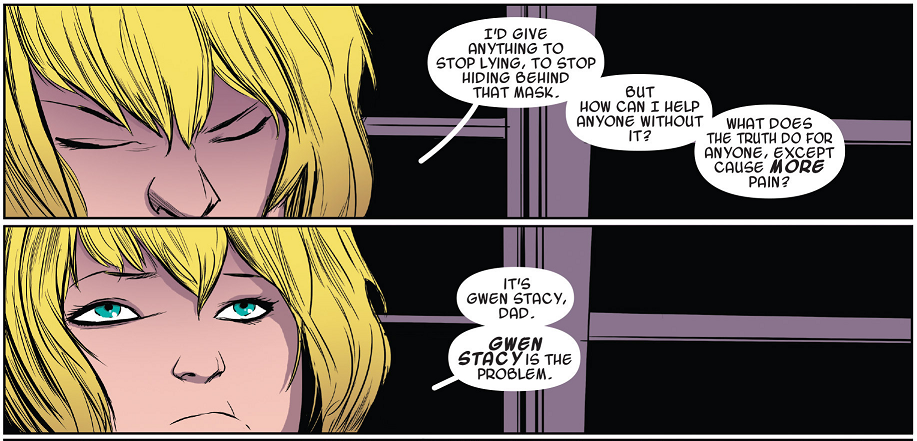
Yet as human as Gwen was, writer Jason Latour seemed to have a difficult time separating this story from Spider-man’s, which left it feeling over-used and tired. Moreover, while both characters suffered guilt over their failure to save a loved one, Peter’s story progressed to the point where the majority of citizens had forgiven him – or at least no longer vilified him. Gwen is currently still reviled by the citizenry and the police, despite her best efforts to be heroic. Future issues may take this into consideration, but at the moment a man was forgiven while a woman is despised for the same crime. Early in the series, there were several noted female side characters, but they didn’t get much more characterization then a panel or two initially. As the series progressed however, the subplots connected and the only characters Gwen actually relied on were her friends and Peter’s Aunt May. When Gwen doubted herself as a hero and as a person, she talked to Aunt May who gave helped work her through her feelings and gave her the support she needed. It was both Aunt May and her friend’s support and words that gave her heart and kept her going. There were several male characters as well, but Gwen didn’t rely on them – in fact she often defied them to do what she felt was the right thing.
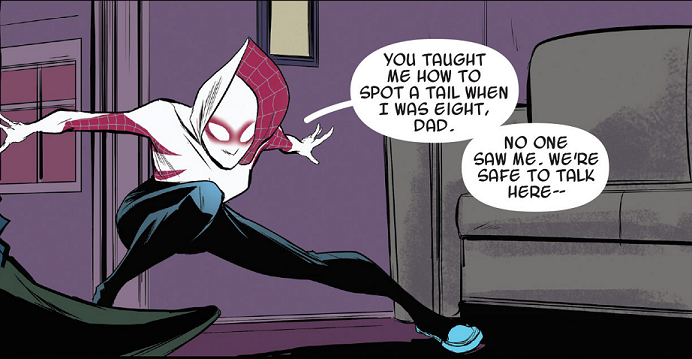
There was a subplot in the series that was traditionally “feminine” concerning a band of all of Gwen’s girl friends, but it was mentioned that it folded into the main plot, and did so again later in the series, therefore actually serving a purpose rather than “girly” flavor text. As for the art in the comic, drawn by Robbi Rodriguez, Gwen’s costume was fairly modest, covering her whole body in a similar fashion to Spider-man’s, however it was made with a more feminine color scheme, including shades of pink instead of red. This color change might have been an attempt to differentiate Spider-Gwen from Spider-man visually, or it could also just have been an attempt to make the costume visually more feminine. The action poses were not sexual at all, and seemed to be fairly attainable if one were to physically train themselves. Despite the positions being a touch awkward, nothing seemed unrealistic, and there was no intense detail on Spider-Gwen, marking her as in no way a sexual character, and instead leaving the emphasis on her personality.
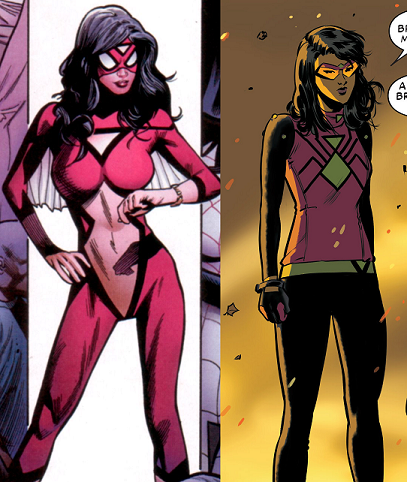
The most noticeable thing about the series Spider-Woman was that the art was poorly done. Artist Greg Land not only drew Spider-Woman disproportionately slender with large breasts, but every female in the comic as well. While Spider-Woman’s costume was not overly sexual in and of itself, there were several scenes where there was unnecessary detail and overly sexual battle positions. This included lines along her torso and back end that made it appear as if her costume was so tight her naval could be seen. In Issue 5, the artist changed to Javier Rodriguez which brought along not only a new costume, but also better proportioned art and less sexualized positions. As for the story, Spider-Woman (Jessica Drew) was tasked with protecting Silk from interdimensional attackers. Later in order to gather information on the self same attackers, she had to pretend to be the paramour of one of the attackers. While the sexual themes included there were less than pleasing, the character wasn’t pleased about it and only tolerated it for half an issue. The plus side of this series was that there were several well-established female side characters and Spider-Woman forged strong friendships with them. She allied with Spider-girl, Spider-Gwen, and Silk throughout the first 5 issues, becoming friends with them despite the trials of dimensional travel. Later in the series, Spider-Woman called upon her best friend Captain Marvel (Carol Danvers) to provide emotional support when she decided on a life change – to quit the Avengers and return to stopping street level crime. None of the female characters existed for appearances sake, and all of them progressed either the plot or the character development of Spider-Woman. Also after Issue 5, Spider-Woman became more compassionate, going out of her way to try and save the lives of the families of lower-level super villains despite her personal biases. This presents the character as strong, unafraid of fighting, but also well rounded and compassionate.
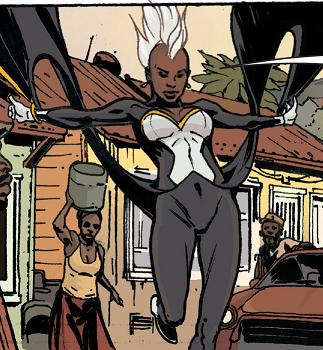
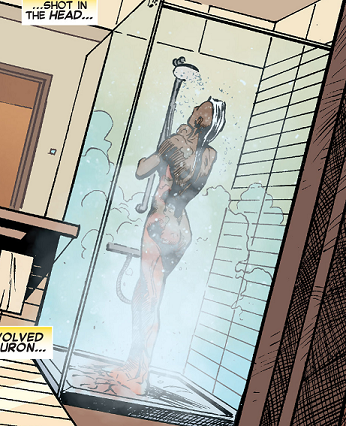
Storm, aka Ororo Munroe, is a character that dates back to the 1970s X-Men comics. In this series, Storm took on crime clans and natural disasters, going out of her way to save civilians and even hateful government officials from harm. Storm as a character is a picture of fierce strength balanced with compassion. Throughout the series, Storm wielded her weather powers to fight injustice and save lives, even going so far as to carry a plane with a burnt-out engine the remainder of its five-hour flight to allow a donated organ to arrive on time. She continually tried to reach out to children and help them through their suffering even if that meant letting the children go. She also acted as an inspiration to others in the story, from her mutant peers to civilians rallying to support her. In that vein, she was widely loved and respected by everyone in the story. There was a strong romantic subplot in the story, but it is made clear early that the romance is on her terms, and she shares equal control over the relationship with her boyfriend, Wolverine. Later in the series when he died, the subplot became driven character development as Storm had to deal with the death of the man she loved. On one hand, this proved to be a chance to see a more emotionally raw version of the character, contributing to her growth throughout the series. On the other hand, one could argue that the entire subplot was unnecessary as the character develops very little after the initial grief. Also, the series lacked continually reoccurring female side characters. There were several that made and appearance, but only for an issue or two before returning only for the conclusion. The supporting cast was predominately male, which brought no aspect of feminine friendship or bonding to the comic. The art was, once again, overly detailed presented in a way that made Storm look as if she had been drawn nude, then colored in. There were many sexualized positions and poses in the comic, as well as an unnecessary shower scene. Storm’s costume was slightly revealing as were her street cloths, but one could argue that, in previous comics, the character had established her comfort with her own body and sensuality, being unafraid to walk around partially or entirely nude. While the character herself seemed to be a role model for balancing strength and compassion, the sexualization and lack of supporting female characters left the series lacking.
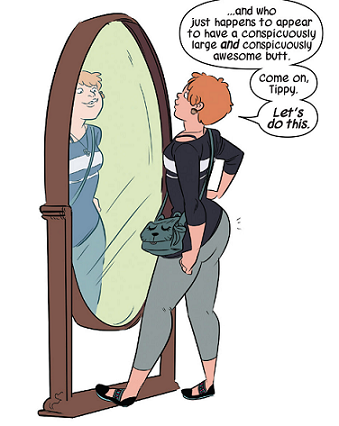
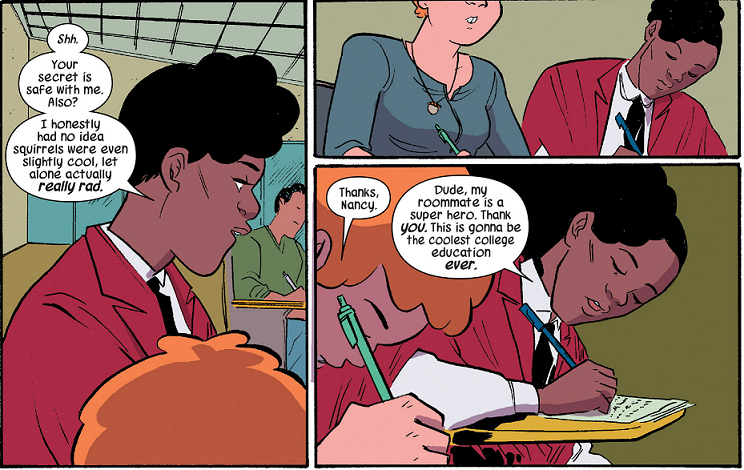
Despite the name, despite the fact that the main character is a super heroine with squirrel powers, The Unbeatable Squirrel Girl is actually a very positive read. Squirrel Girl (Doreen Green) is a quirky, funny college-age girl, and the comic itself shows her exploits balancing college life, being a superhero, and making friends. Right away the character was endearing and charming as well as fully developed. Squirrel girl was a great mix of strength, self confidence, and compassion. In the first issue alone, she took out a group of muggers with her strength and skill, and managed to talk down the first villain she faced. Despite being drawn slightly thicker than the average female super hero, she carried herself with confidence in her appearance. She also chose to go to college to better herself, claiming that superhero’s need more than just strength. While moving in to her dorm, she explained to her squirrel friend, “There’s more to being a superhero than just being the strongest” (North, The unbeatable Squirrel Girl, 5.1A). Immediately the comic set up and developed a female side character for the story, giving her purpose and personality while emotionally supporting Squirrel Girl. Throughout the story, Squirrel Girl was able to accomplish amazing feats like stealing Iron Man’s armor and traveling to the moon. Never once did she doubt herself, and there was no question about her mix of ability and intelligence – she may have acted goofy, but she achieved her goals by skill and thought rather than dumb luck. There was a minor romantic subplot in the story, but it was downplayed to the overarching plot and it served as character development for both Squirrel Girl and her love interest, Chipmunk Hunk. Squirrel Girl mixed compassion and strength when fighting villains, unafraid to use her fists but also helping those that need it first. In one issue, she managed to talk down Galactus the devourer of worlds, befriending him and helping him find a better planet to eat than Earth. She also played a leadership role amongst her friends, taking control of her own minor super team and guiding them when they were in over their heads. Her costume was modest all around as were her street clothes, with no excessive exposed skin or extreme detail. Her poses, too, were not sexual in any way, focusing more on action than on highlighting strange angles or female anatomy. Not only was the character strong, but the art was well done too.
This series was a new step for Marvel comics, changing the classic character of Thor Odinson, God of Thunder, to Thor, Goddess of Thunder. To change the sex of a character from male to female is a bold step that puts the series up to high standards. After Thor Odinson became unworthy of wielding mjolnir – his hammer – in the most recent Marvel universe story arc, a female character – Dr. Jane Foster, currently suffering from breast cancer – stepped in to take over the title of Goddess of Thunder. Right away this is an empowering thought – a human woman being worthy to wield the power of a god so readily – but the comic suffered from some great flaws. For one, the series began by focusing almost entirely on the male Thor (from this point on called “Odinson”), rather than the new female Thor.
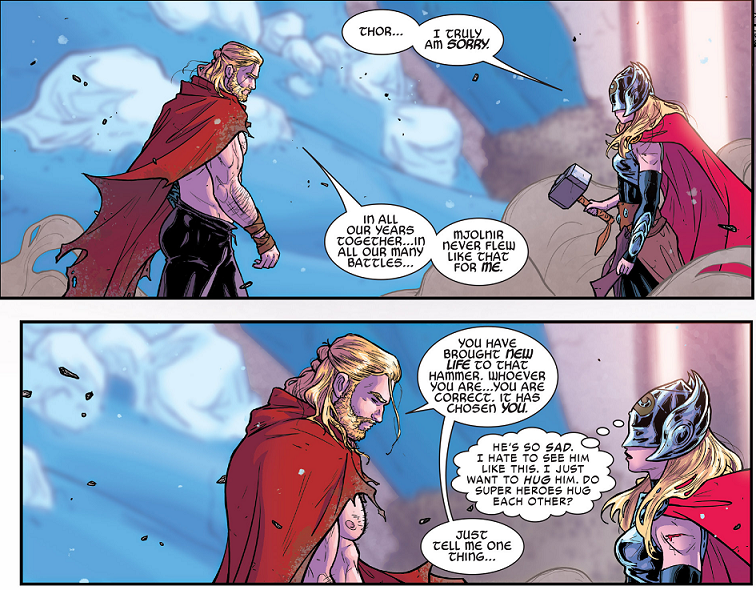
It was necessary to illuminate the background of the new character and how she had come to be, but several issues in, Odinson was still a large driving part of the story. It focused on Odinson’s grief at the loss of his hammer and his confusion as to the new Thor’s identity. This detracted from the magnitude of the new character, placing her firmly in the old ones shadow. Despite Thor saving the world from an invasion of frost giants, her heroic actions were downplayed by the plight of Odinson. Odinson continued to remain a key source of plot through the entirety of the comic to date, which prevented Thor from standing on her own as a character. One could argue that it served as build up to the reveal of the new Thor’s secret identity; however it takes eight issues to get to that point, which seems excessive. In addition to that, Odin returned from his time away from the land of Asgard and immediately uprooted his wife Freyja from the role of leader which she had taken up in his absence. Freyja had been ruling Asgard well and peacefully for the entire time Odin had been away, and with his return he expected immediate obedience on his wife’s part, claiming that her leadership had only been worthwhile because of his absence. This implied women to be subservient to men and lesser rulers, despite their accomplishments. However, there were several positive themes in the comic as well. The story began with the female characters being the only reasonable ones – Odinson himself was lost in self-pity while Odin was unreasonably enraged. Freyja, Odinson’s mother, became an integral part of the story early, being the only one to accept and support Thor almost immediately. Freyja even defied her husband’s will, making efforts to help Thor save the Earth from Odin’s own unprovoked, violent actions. When Odin sent the Destroyer to Earth with the intention for taking back mjolnir, it was Freyja who ultimately stopped it. She proved to be a strong, well-developed female supporting character from early in the comics, providing a level of female bonding that helped the character of Thor grow into her role. Thor herself began the comic unsure of her powers and limits, fighting internally as well as externally to overcome her doubt while putting up a front of confidence. Yet, regardless of her fears and insecurities, Thor’s first priority was always to do the right thing and heroically save lives, which make her both inspiring and realistic. In one of Thor’s first superhero fights, she was faced with the villain Absorbing Man, who refused to recognize her as Thor because of her sex. He mocked her, saying, “Thor? Are you kidding me? I’m supposed to call you Thor? Damn feminists are ruining everything!” (Aaron, Thor, 8.A1) The tides were turned when the Absorbing Man’s partner and wife Titania joined the battle, knocking her own husband out and agreeing to go to jail quietly, out of respect for breaking the gender barrier.
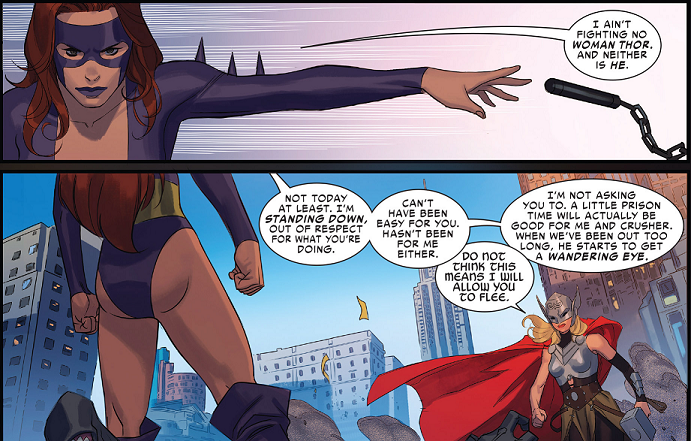
This was a greatly heartening moment – to believe that the comic is fighting gender stereotypes is one thing, but to see an example of it written into the comic really drove the message home. Later, Thor and the other male characters with the exception of Odin grew to at the very least respect her efforts despite them all being more familiar and friendlier with Odinson. He willingly bequeathed her his name and relented to the fact that she was worthy, and he was not. The art in this comic, drawn by Russell Dauterman, was also done well. Thor wore a costume on par with Odinson’s former garb while Odinson himself was the sexualized one, walking around without a shirt. While this was unequal treatment of characters, it is also the only time such a thing has happened in any of the comics examined for this study. Her costume occasionally was drawn with sculpted breast cups, but this happened rarely throughout the series. Thor fought very physically, but her battle stances and poses were also on par with Odinson – not sexual or unattainable physically. This presented her as equal to her male counterpart when he was Thor – a hero first, with sex playing little to no part in the character.